Dr Yousif Al Hammadi Appointed CEO of Tabreed
Tabreed has named Dr Yousif Al Hammadi Chief Executive Officer, the first CEO chosen from within the UAE district cooling group.
 Khushboo Singh
◆15 October 2026
◆4 min read
Khushboo Singh
◆15 October 2026
◆4 min read
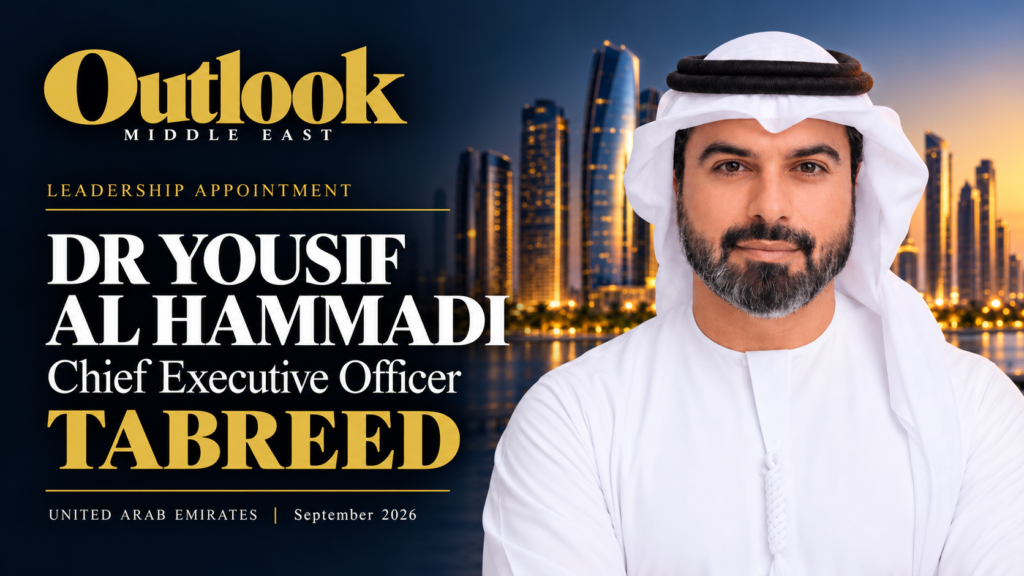
Abu Dhabi, UAE: National Central Cooling Company, known as Tabreed, appointed Dr Yousif Al Hammadi as Chief Executive Officer on September 11, 2026. The decision marks the first time the company has selected a new CEO from within the group.
Al Hammadi had served as Interim CEO since January 2026. His permanent appointment follows a career at Tabreed spanning projects, business development, asset management and executive leadership, giving him direct experience of the business he now leads.
A Leadership Career Built Within the Business
Al Hammadi joined Tabreed in 2014 and became Chief Asset Management Officer in 2022. During his time at the company, he contributed to major transactions and development initiatives, including the acquisition of Downtown Dubai’s district cooling infrastructure, the PAL Cooling acquisition and the Palm Jebel Ali concession.
Before joining Tabreed, he held positions at Mubadala, ADNOC and the Ministry of Interior. His wider career includes more than two decades of work connected with strategic and infrastructure initiatives.
The appointment therefore combines internal experience with exposure to other major UAE institutions. Tabreed’s announcement also linked the decision to its commitment to developing national talent and supporting progression into senior leadership.
Al Hammadi’s stated priorities include improving returns from the existing portfolio, realising value from strategic investments and maintaining a disciplined approach to further opportunities.
A Larger Operating Base
The new CEO takes charge after substantial portfolio expansion. In its first-half 2026 results, Tabreed reported connected capacity of 1.58 million refrigeration tons, approximately 15% higher than a year earlier.
Revenue increased by 2% over the same period, while EBITDA reached AED 615 million, representing a margin of 55%. The company reported net profit of AED 192 million.
Operating cash flow increased by 40% to AED 632 million. Tabreed also reported net debt to EBITDA of 4.57 times at the end of the first half.
The results highlighted higher financing costs, including the effect of refinancing and debt associated with growth investments. Together, these figures show why the next stage of leadership involves both operational delivery and financial management.
Moving From Expansion to Value Creation
Tabreed’s recent growth has included the PAL Cooling acquisition alongside CVC DIF and the Palm Jebel Ali concession. The company previously described these as the two largest strategic transactions in its history.
In its 2025 growth disclosures, Tabreed said the transactions expanded its total site capacity to approximately 2.6 million refrigeration tons. Site capacity and connected capacity measure different aspects of the business and should not be treated as interchangeable figures.
From a business perspective, acquisitions and concessions create opportunities, but their value emerges over time. Management must connect investment decisions with customer demand, asset utilisation, operating performance and financing requirements.
That makes Al Hammadi’s background in asset management particularly relevant. The company’s next phase will require attention to the performance of infrastructure already acquired or developed, alongside decisions about future expansion.
Why the Appointment Matters for Infrastructure Leadership
District cooling is a long-term infrastructure business. Its leadership decisions can have consequences that extend well beyond a single reporting period, especially when capacity is built ahead of full customer demand.
An executive team must therefore balance near-term financial results with the requirements of assets expected to operate for many years. Maintenance, reliability, customer commitments and capital expenditure need to be considered together.
Internal leadership experience can be useful in this setting because it provides familiarity with existing projects, operating practices and stakeholder relationships. However, continuity is valuable only when accompanied by clear performance standards and a willingness to address weaknesses.
This is the central analytical significance of the appointment: Tabreed has selected a leader already familiar with its expansion to oversee the work of converting that expansion into durable commercial returns.
Financial Discipline Will Remain Important
The first-half results illustrate why investors are likely to watch cash generation as closely as reported profit. Tabreed’s stronger operating cash flow provides useful context, while its financing costs demonstrate that expanding an infrastructure portfolio also creates obligations.
A larger asset base can support future earnings, but growth must be funded and integrated. Decisions about additional investment should therefore be assessed against expected returns, funding costs and the demands of the existing portfolio.
For customers, the priorities are more immediate: reliable service, consistent delivery and confidence that the operator can meet long-term commitments. Financial resilience and operational reliability are connected because both depend on sustained investment and sound management.
The Measures That Will Define His Tenure
Future reporting will help establish whether the enlarged portfolio is delivering the expected benefits. Useful indicators include connected capacity, operating cash flow, financing costs, leverage and the commercial contribution of recent investments.
Al Hammadi’s appointment gives Tabreed continuity at an important stage in its development. The substantive test will be whether the company can maintain service performance, strengthen its financial position and convert its expanded infrastructure platform into sustainable value for customers and shareholders.