Top 10 Emerging Leaders Shaping the Future of the UAE in 2026
Meet 10 UAE founders making headlines in 2026, from Shark Tank Dubai deals to Series A rounds in fintech, beauty, proptech and femtech.
 Khushboo Singh
◆16 October 2026
◆10 min read
Khushboo Singh
◆16 October 2026
◆10 min read
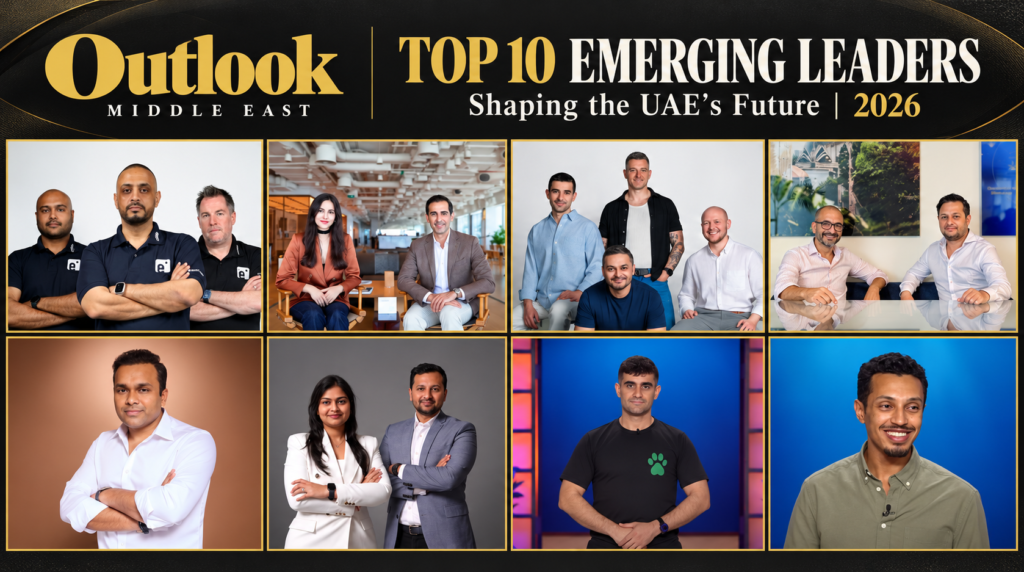
The UAE has always rewarded people who move early. In 2026, that reward is going to a new generation of founders who are building for the region first and the world second, and who are being noticed for it. Some of them walked into the Shark Tank Dubai studio and walked out with a cheque. Others closed seed and Series A rounds that put Dubai and Abu Dhabi on the maps of investors in London, Vienna and New York. What they share is a willingness to solve problems that are specific to this part of the world, whether that is how rent gets paid, how a pet is cared for when its owner travels, or why the Arab world has never produced a global character brand of its own.
This article presents ten of those leaders. They are not the billionaires or the household names. They are the people whose stories broke in the last eighteen months, and whose next chapter is still being written. Their work is a reminder that the UAE’s future is being shaped as much in co-working spaces and cloud kitchens as in boardrooms.
Meet the founders who turned a pitch, a product or a problem into one of the UAE’s most talked-about ventures of the year.
1. Fadi Arab and Farah Merhy: Building the Arab World’s Own Collectible Brand
Fadi Arab and Farah Merhy co-founded A22, a Dubai consumer IP company, around one question: why has the Arab world never produced a global character brand of its own? Their answer was Dabubu, a culturally rooted collectible character that launched publicly in December 2025 and reached an organic audience of 43 million people. The first drop sold out in two hours, and the brand has since moved into confectionery, fashion and accessories.
The story reached a wider audience on 12 October 2026, when A22 appeared on the Season 4 premiere of Shark Tank Dubai on Dubai TV. Four Sharks made offers. The founders chose Toufic Kreidieh, who invested AED 1.2 million for a 20 percent stake. The company has registered its trademarks in the United States and China, and a limited “Golden Drop” edition embedded a real 18K gold tag in ten of 2,000 units.
Arab, who serves as CEO, has described Dabubu as a proof of concept rather than the end goal. The ambition is a portfolio of Arab characters with the reach of the brands children grow up with everywhere else. With Shark Tank backing and early traction that most consumer brands would envy, A22 is one of the UAE’s most interesting bets on culture as an export.
2. Mostafa Khattab: Cutlery That Grows Into a Garden
Mostafa Khattab founded Bloomspoon in Dubai in 2023 with a product that sounds like a riddle: reusable cutlery you can plant. Each wheat-straw spoon and fork carries a water-soluble capsule of basil or mint seed, so that when it reaches the end of its life it becomes a herb pot rather than landfill. Bloomspoon describes itself as the first brand in the world to offer plantable cutlery, and it has been covered by Reuters, Forbes Middle East and Dubai One TV.
In May 2025, Khattab pitched on Season 3 of Shark Tank Dubai and received an offer of AED 800,000 from Toufic Kreidieh, executive chairman of BFL Group, for a 49 percent stake. The capital is earmarked for regional expansion, new product lines, retail distribution and B Corp certification. For a company barely two years old, the attention was a signal that sustainability products made in the UAE can compete on design and not just on good intentions.
Khattab has said that Bloomspoon is in the business of building habits, not just products. The next phase is about getting the cutlery onto supermarket shelves and into hotel chains across the Gulf. His story is a small, concrete example of how a single-product idea can become a sustainability brand when the founder is relentless about distribution.
3. Joey Chaaya: Cage-Free Care for the UAE’s Pets
Joey Chaaya, a Dubai-born Lebanese entrepreneur, co-founded PetBae with Kareem Costenoble after an idea that first took shape in 2019. The platform launched publicly in the autumn of 2021 as a marketplace connecting pet owners with vetted, home-based, cage-free sitters. By mid-2025 it had attracted around 12,000 sitter sign-ups, of which roughly 2,000 were approved and about 1,000 were actively taking bookings, with a 65 percent retention rate and a 50 percent repeat-booking ratio.
PetBae reached a national audience on Shark Tank UAE, where it secured what the company described as the highest investment offer on its episode. In a January 2026 interview with Gulf Business, Chaaya said organic traction and app installs spiked across every channel after the broadcast. The company earns a 20 percent commission on sitter earnings plus a 5 percent service charge to owners, and its early capital came from the very pet owners who used it.
The roadmap now includes grooming, pet insurance, Abu Dhabi and the wider GCC. Chaaya has repeatedly credited Dubai as the foundation of the business, and PetBae is one of the clearest examples of a consumer marketplace that found product-market fit by solving a problem its founders lived themselves.
4. Purvi Munot: Making Financial Intelligence Everyone’s Infrastructure
Purvi Munot co-founded Sav in 2022 with Mithil Ajmera, and in September 2026 the UAE fintech closed a USD 3.5 million pre-Series A led by Phoenix Venture Partners, taking total funding to around USD 6 million. Sav is an AI-powered personal finance platform that brings a user’s accounts, savings, investments, credit and payments into one place, and it runs on a proprietary AI layer the company calls SavCore.
Sav holds a DFSA Category 4 licence and earns revenue from interchange, wealth fees, commerce commissions and subscriptions. The new capital is directed at expansion into Saudi Arabia, further investment in AI infrastructure and user acquisition. For a product category that has struggled to find durable business models elsewhere, Sav’s multi-stream approach is an attempt to make everyday financial management both useful and sustainable.
Munot has framed the mission in a single line: financial intelligence should not be a privilege for the few, but infrastructure available to everyone. In a region where personal finance tools are still catching up with payments innovation, Sav is one of the UAE’s most closely watched consumer fintechs heading into 2027.
5. Shubham Poddar: Arab Ingredients, Global Standards
Shubham Poddar left Sequoia Capital India to build a beauty brand, and in December 2024 he launched AÏZA under his Dubai company Amaani. The brand formulates skincare and haircare around ingredients with deep roots in the region, including dates, black seed, frankincense, rose and bakhoor, developed with laboratories in Korea, Japan and Italy. The pitch is simple: Arab heritage, world-class formulation.
The market responded quickly. Net revenue grew more than nine times year on year in the first half of 2026, and on 29 September 2026 Amaani announced a USD 5 million Series A led by BECO Capital, with Homegrown Ventures and Peak XV’s Surge participating, taking total funding to USD 8 million. The brand has moved from digital-first to physical retail, with Ulta Beauty launches in Jeddah and Riyadh in late September and Kuwait and Qatar planned for the fourth quarter.
Poddar has said the funding allows AÏZA to deepen what it has built in the UAE and expand across the GCC. The company is a case study in how a former investor can turn a thesis about regional consumer demand into a brand that competes with global houses on their own shelves.
6. Omar Abu Innab: Paying Rent the Way Salaries Arrive
Omar Abu Innab co-founded Keyper in 2022 with Walid Al Saqqaf to fix one of the most persistent frictions in UAE life: the annual rent cheque. Keyper lets tenants pay rent monthly while landlords are paid upfront, and it has built partnerships with the Dubai Land Department, ADRES, Property Finder, Visa and Mashreq to make that work at scale.
On 9 July 2026, Keyper closed a USD 11 million Series A led by Speedinvest, with NeoVentures (Mashreq), MEVP, Dubai Future District Fund, Property Finder, Arab National Bank, Ellington and Dar Ventures also investing. The platform now supports more than 10,500 properties worth over USD 6 billion, serves around 4,000 landlords, has passed 100,000 app downloads and has financed more than USD 44 million in rent, USD 19 million of it in 2026 alone.
Abu Innab’s stated goal is a fully digital journey for owners and renters alike. By embedding financing into a routine transaction that millions of residents make every year, Keyper is one of the UAE proptechs most likely to change behaviour rather than just digitise paperwork.
7. Sanjar Samiev: Giving SMEs the Payment Terms They Deserve
Sanjar Samiev co-founded Comfi in 2023 after seeing first-hand how disruptive long payment cycles are to a small business’s operations. The UAE-headquartered company offers B2B buy-now-pay-later: suppliers can extend up to 90-day terms to customers and still get paid within 24 hours. Since launch it has processed more than 15,000 invoices for over 1,000 clients and brought more than 4,000 finance leaders onto the platform.
In April 2026, Comfi announced a USD 65 million pre-Series A combining equity and debt. The equity was led by Iliad Partners with Yango Ventures and Raw Ventures, while Partners for Growth provided a credit facility and Shorooq provided mezzanine financing. It followed a USD 5 million debt facility in June 2024 and gives Comfi the balance sheet to expand across MENA.
Samiev has built Comfi with co-founders Alisher Akbarov and Amal Abdullaev, and the company’s growth reflects a wider shift in Gulf fintech from consumer payments toward the unglamorous plumbing of business-to-business trade. For SMEs that have long been squeezed between slow-paying buyers and impatient suppliers, that plumbing matters.
8. Pravin Rai: Ambition Measured in Hours, Not Days
Pravin Rai founded QuicKart, a UAE fresh-commerce platform built around dairy and perishable produce, with a promise of farm-to-home delivery. In February 2026 the company raised a USD 1.5 million seed round led by Orbit Ventures, with regional family offices and angel investors participating, to build out its own fulfilment network and climate-controlled fleet.
QuicKart operates hubs in Dubai, Sharjah and Ajman, with an Abu Dhabi launch planned. Its model differs from general quick-commerce in that it is vertically focused on the goods that spoil fastest and where a few hours of delay destroy both quality and margin. By owning the cold chain rather than renting it, the company hopes to control the one variable that matters most in fresh food.
Rai’s one-line summary of the business is that its ambition is measured in hours, not days. It is an early-stage story, but one that speaks to the UAE’s food security agenda and to a consumer base that increasingly expects fresh produce on its own schedule.
9. Torkia Mahloul: Timely Care for Women’s Health
Torkia Mahloul co-founded Ovasave, an Abu Dhabi-based femtech company incubated at Hub71, with Majd Abu Zant. The platform focuses on fertility and hormonal health, from at-home testing and consultations to menopause support, and it is registered with the Department of Health – Abu Dhabi. In a “Fertility Your Way” campaign with Merck Gulf, Ovasave screened more than 500 women free of charge.
In July 2025, Ovasave secured USD 1.2 million in pre-seed funding led by PlusVC, Annex Investments and New York-based 25 Madison, with UAE and Saudi angels and family offices participating. The company works with corporate partners including Aldar, BCG and WeWork on employee benefits, and says it has supported more than 10,000 women and couples. In October 2026 it was profiled by Entrepreneur Middle East as a Future 100 winner.
Mahloul has argued that there is a critical need for timely intervention in women’s health, particularly around fertility. With expansion into Saudi Arabia underway, Ovasave is one of the Gulf’s most visible attempts to make that intervention routine rather than exceptional.
10. Osama Shawky: Rethinking the Extended Stay
Osama Shawky is a six-time founder with three exits who previously led commercial teams at Orange Business and Concentrix before launching estaie, a Dubai proptech focused on extended-stay accommodation. The platform targets the gap between short-term holiday rentals and annual leases, serving professionals and relocating families who need furnished homes for weeks or months rather than nights or years.
In April 2026, estaie secured a seven-figure pre-seed round led by PlusVC and Orbit Ventures. The funding is aimed at expanding inventory and technology in the UAE, where a steady flow of inbound talent has made mid-term housing one of the fastest-growing segments of the property market.
Shawky’s track record as a serial founder gives estaie an operator’s instinct that many early-stage proptechs lack. His bet is that the extended stay will become its own category with its own rules, and that the UAE is the right place to prove it.
Conclusion
The ten founders in this list did not inherit their platforms. They built them from a product, a pitch or a problem they could not ignore, and in the last eighteen months the market noticed. Shark Tank Dubai has given consumer brands like A22, Bloomspoon and PetBae a national stage, while investors from Vienna to New York have put real capital behind UAE fintech, proptech, beauty and femtech. As 2027 approaches, their progress is a reminder that the country’s future is being shaped by people who are still early in their journeys, and who are moving with the speed the UAE has always rewarded.