Egypt credit rating upgraded to B3 by Moody’s
Moody’s raised the Egypt credit rating to B3 with a positive outlook, citing lower debt, USD57bn reserves and reforms that may cut interest costs faster.
 Layla Al Mansoori
◆18 October 2026
◆4 min read
Layla Al Mansoori
◆18 October 2026
◆4 min read
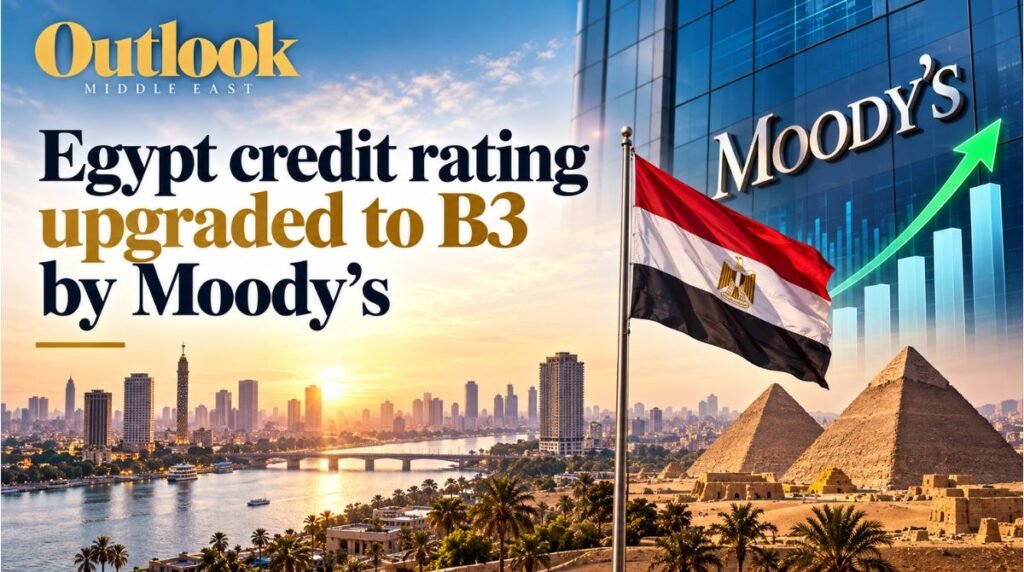
Moody’s has raised the Egypt credit rating to B3 from Caa1 and kept a positive outlook, citing lower debt and firmer public finances, in a decision announced on Friday 16 October.
The upgrade covers Egypt’s long-term issuer ratings in both local and foreign currency, as well as its foreign-currency unsecured debt, the Egyptian Cabinet said in a statement carried by Ahram Online. The positive outlook leaves room for a further upgrade if debt and interest costs fall faster than the agency currently expects.
Moody’s said the decision reflected “tangible results of fiscal consolidation efforts and ongoing structural reforms”, according to Egypt Today, which cited Al-Qahera News. The agency also credited the move to a flexible exchange rate and tighter monetary policy with strengthening foreign currency reserves and the economy’s ability to absorb shocks.
What drove the Egypt credit rating upgrade
Public finances have improved markedly over three years. Egypt posted a primary surplus of 4.6% of GDP in the 2025/26 fiscal year, or 4.1% excluding one-off revenues, up from 3.5% a year earlier and 1.6% in 2022/23, according to figures cited by EnterpriseAM Egypt.
Tax revenues reached 13% of GDP, a rise of 1.6 percentage points over two years, the Ministry of Finance said. The ministry stressed that the increase came without adding new burdens on citizens or investors.
Government debt stood at 81.9% of GDP in June 2026, the ministry said, down from 95.2% in June 2023. Moody’s expects the ratio to fall below 70% by the end of the decade, EnterpriseAM reported.
The interest bill remains the main weakness. Interest payments absorbed about 59% of government revenues in 2025/26, down from 63% a year earlier, and Moody’s expects that share to approach 50% over the coming years. That burden is still heavier than at most similarly rated sovereigns.
On the external side, Egypt’s net international reserves climbed to more than USD57bn in September. Remittances rose almost 30% to USD47.3bn in 2025/26, while tourism revenues grew 10.3% to USD18.4bn, EnterpriseAM reported.
Moody’s expects the government to maintain fiscal discipline and continue reforms after Egypt’s current IMF programme ends in December 2026, Egypt Today reported.
How the Moody’s Egypt upgrade compares with S&P and Fitch
The Moody’s Egypt upgrade narrows, but does not close, the gap with the other two major agencies. S&P Global affirmed Egypt at B and Fitch kept its B rating earlier in October, both with stable outlooks, leaving them one notch above Moody’s new B3.
Moody’s is now the only one of the three with a positive outlook. All three agencies have identified the high interest bill as the principal constraint on Egypt’s public finances.
Egypt’s government is also moving ahead with capital-market plans. The state intends to list a 30% stake in Banque du Caire on the Egyptian Exchange, a sale that EnterpriseAM reports could be enlarged to 45% to meet a EGP30bn target.
Why it matters for the region and what comes next
A stronger Egypt credit rating typically lowers borrowing costs for the government, banks and large corporates, and widens the pool of international funds able to hold Egyptian debt. That matters for a country that still relies heavily on external financing and faces elevated oil import bills while the Strait of Hormuz remains disrupted.
The Ministry of Finance said the upgrade reflected the economy’s improved ability to withstand external shocks and sustain growth. It pledged further structural reforms, simpler procedures and stronger competition to lift private investment, and said it wants more fiscal space for health, education and targeted social protection.
The ministry also said that cutting debt-service costs “at a faster pace” is now the focus of the next phase of reform, Daily News Egypt reported.
Gulf investors have a direct stake in the outcome. UAE, Saudi and Qatari sovereign funds and banks hold significant Egyptian assets, and the Egypt debt-to-GDP trajectory will shape how quickly the country returns to international bond markets at tighter spreads.
Moody’s has set out what would trigger the next upgrade: debt and interest costs falling faster than its baseline, a pickup in growth and revenue collection, and local borrowing costs easing as inflation slows. Mashreq Capital expects the Central Bank of Egypt to keep its deposit rate at 19% through year-end, with cuts starting in 2027, EnterpriseAM reported.
For more on regional sovereign and corporate credit, see our banking and financial services coverage and the latest MENA business news. The Cabinet statement on the upgrade is available via Ahram Online.