GCC foreign outflows hit record $2.3bn in Q3, Kamco says
GCC foreign outflows hit a record USD2.3bn in Q3 2026 as overseas investors sold Saudi, Dubai and Kuwait stocks while local buyers stepped in, Kamco says.
 Layla Al Mansoori
◆18 October 2026
◆4 min read
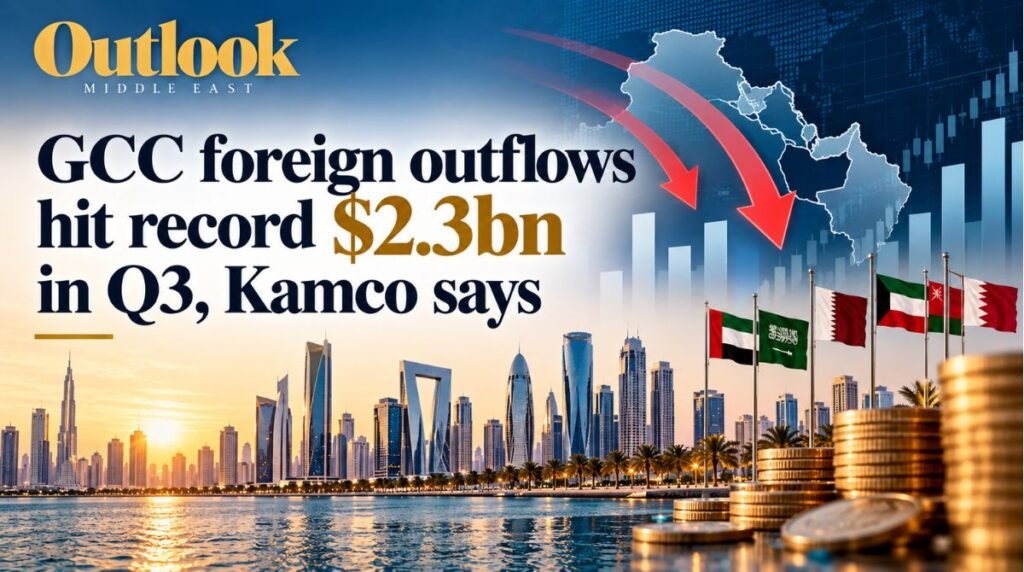
Foreign investors sold a net USD2.3bn of GCC stocks in the third quarter, the largest quarterly GCC foreign outflows since Kamco Invest’s records began in 2019, the Kuwaiti investment firm said.
The selling marked a sharp escalation from net foreign sales of USD298.3m in the second quarter, according to the Kamco Invest report, which was published this week and reported by Arab News and Gulf Daily News. Saudi Arabia accounted for USD1.5bn of the outflow, reversing foreign purchases of roughly the same size in the previous quarter.
Kamco said in its release that “GCC equity markets witnessed divergent trends during Q3-2026”, pointing to geopolitical developments, investor sentiment, corporate earnings and sector performance as the main drivers.
Where the GCC foreign outflows landed
Dubai saw net foreign selling of USD414.3m and Kuwait USD284.1m, the report showed. Abu Dhabi recorded a modest USD36.1m outflow, Oman USD26.5m and Bahrain USD21.8m.
Qatar was the only market to attract net foreign buying, at USD10.9m. Foreign investors were net sellers in Saudi Arabia, Dubai and Kuwait in every month of the quarter, while Abu Dhabi saw buying in July before selling in August and September.
Over the first nine months of 2026, foreign investors were net sellers of USD1.1bn across the GCC, compared with net purchases of USD11.7bn in the same period of 2025. They were net sellers in five of the nine months.
Vijay Valecha, chief investment officer at Century Financial, told Arab News that international investors were worried about “the possibility that expanding hostilities could disrupt exports”, as geopolitical risk in the region rose over the summer.
Local investors step in as trading values fall
Domestic buyers absorbed much of the selling. Local investors across the GCC were net buyers of USD760.7m in the third quarter, reversing net sales of USD921.2m in the second quarter, Kamco said.
In Saudi Arabia, local investors turned to net buying of SAR5.6bn (about USD1.49bn) after net selling of SAR5.8bn in the prior quarter, led by institutions with net purchases of SAR5.9bn. Investors from other GCC states bought a net USD323.3m of Saudi stocks, more than in any other regional market, and USD27.2m in Abu Dhabi.
Even after the quarter’s selling, foreign investors remain net buyers of SAR6.7bn of Saudi stocks for the year to date, Arab News reported.
Activity cooled across the region. Traded value fell 14.4% quarter on quarter to USD135bn, while volume dropped 12.7% to 83.1bn shares. Saudi traded value slipped to USD73.8bn from USD86.4bn and Dubai’s to USD10.3bn from USD14.4bn, Gulf Daily News reported.
The ten most traded stocks changed hands to the value of USD28.8bn, or 20.9% of regional turnover, and all were Saudi or UAE names. Al Rajhi Bank led at USD6.6bn, followed by Saudi Aramco at USD3.7bn and Emaar Properties at USD3.6bn.
Banking stocks remained the most active sector at USD30.6bn, down 10.6% from USD34.2bn a year earlier. Real estate, transport and materials turnover also declined, while energy, capital goods and telecoms were relatively firm.
What it means for Gulf stock markets
The scale of the GCC foreign outflows confirms a shift in sentiment that was visible in index performance. The Tadawul All Share Index fell 6.2% in September to its lowest month-end close of 2026, with foreign investors selling a net SAR4.33bn of Saudi stocks that month, EnterpriseAM reported.
A separate outlook from Mashreq Capital, published on 16 October, put net foreign outflows from MENA equities at USD2.8bn in the third quarter on a wider regional basis. The firm cut its full-year regional equity return forecast to 5–7% from 6–8%, and said it prefers the UAE and Oman while remaining cautious on Qatar and Kuwait.
Performance has diverged by market. UAE equities gained 5.3% in the quarter, Qatar fell 9.7%, and Oman leads the region with a 33.1% gain so far this year, according to figures cited by EnterpriseAM. The S&P Pan Arab Large Composite Index slipped 0.6% over the quarter.
Attention now turns to third-quarter earnings, which market participants expect to give investors a fresh anchor. Early reports have been steady: Qatar Islamic Bank lifted nine-month profit 2% to QAR3.5bn, while Emaar Properties reported a sales backlog approaching AED180bn.
Structural reforms may also support a return of foreign investors over time. Saudi Arabia’s Capital Market Authority opened the main market to all foreign investors from 1 February, Arab News noted, and FTSE Russell has placed Oman on its watch list for a possible upgrade to secondary emerging-market status.
Kamco Invest’s quarterly GCC trading reports are published on its research page.